


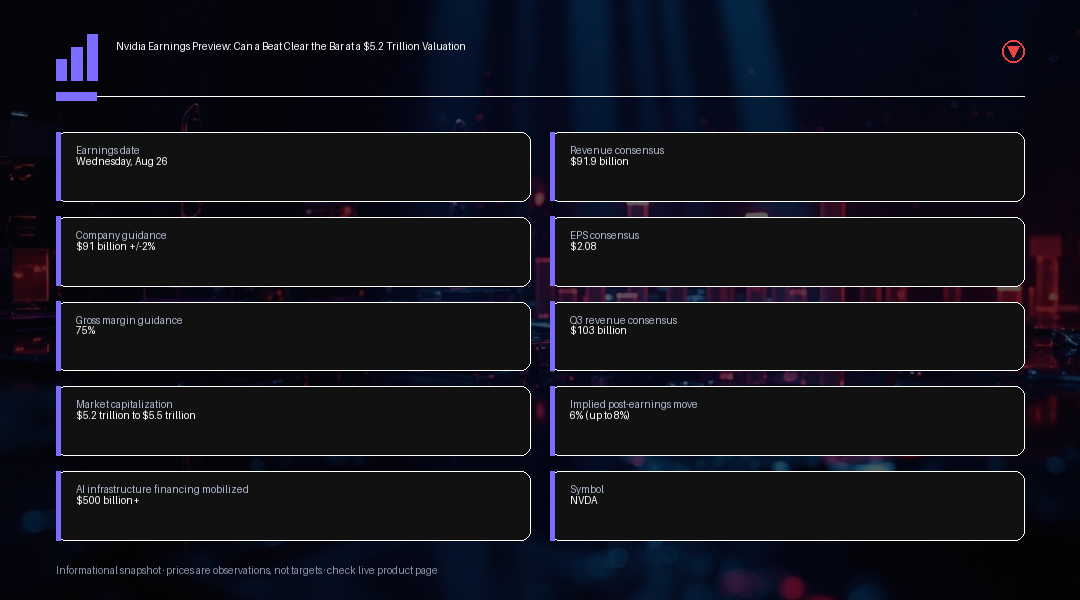
Nvidia reports fiscal second-quarter results after Wednesday's closing bell, and the numbers Wall Street wants to see keep climbing along with the stock's valuation. Consensus calls for adjusted earnings near $2.08 per share on revenue of roughly $91.9 billion, which would be nearly double last year's comparable results. The company's own guidance points to about $91 billion in revenue, give or take 2%, alongside an adjusted gross margin near 75%, a measure of how much revenue remains after production costs. At a market capitalization that has traded in a roughly $5.2 trillion to $5.5 trillion range in the run-up to earnings, simply matching those already-high expectations may not be enough to move the stock, since markets tend to price in a strong quarter well before it is reported.
The tougher test is what comes next. Third-quarter revenue guidance is the figure traders are watching most closely, with consensus estimates sitting near $103 billion. A beat on the just-completed quarter paired with soft forward guidance would likely disappoint, because equity markets are ultimately pricing future cash flows rather than rewarding a strong quarter in isolation. Nvidia has, in fact, beaten consensus estimates in each of its last four reports, only to see its shares fall the following session each time, a pattern that underscores how much good news is already reflected in the price before results land.
Data-center revenue remains the core engine of the business, and traders should listen closely for updates on Blackwell shipment volumes, progress on the next-generation Rubin architecture, and any commentary on infrastructure bottlenecks. Even where chip demand looks effectively unlimited, customers still need power capacity, physical space and completed data-center buildouts before that demand can convert into revenue, and any signs of a widening gap between orders and deployable capacity would be worth flagging.
China remains a genuine swing factor rather than a settled issue. Nvidia's roughly $91 billion guidance excludes data-center compute revenue tied to mainland China, and while reports indicate Beijing has allowed some licensed H200 shipments, a meaningful share of those units are expected to remain outside mainland China, including in Hong Kong. Any commentary suggesting a broader reopening of the Chinese market would represent incremental upside not currently baked into guidance, while continued restrictions would simply preserve the status quo rather than introduce new downside.
Financing commentary deserves scrutiny too. Nvidia has been described as helping mobilize more than $500 billion in capital tied to AI infrastructure projects and is backing select data-center developments. That figure is better understood as a measure of capital mobilization and financing capacity across a broader ecosystem than as Nvidia's own direct spending commitment, and investors will likely press management on how much of that number reflects Nvidia's balance sheet versus partner and customer financing. The concern some investors raise, whether Nvidia is increasingly financing the very ecosystem that in turn finances Nvidia's own revenue growth, is a reasonable question to have answered directly rather than left ambiguous.
Options markets are pricing an implied post-earnings move of roughly 6%, with some estimates running as high as 8% depending on the measurement window and data provider. Given Nvidia's scale, even a move at the lower end of that range translates into hundreds of billions of dollars in market value shifting in a single session, a reminder of how much is riding on a report that will be digested in real time by a market already positioned for a strong outcome.
The checklist for Wednesday is straightforward even if clearing it will not be: revenue above the roughly $92 billion consensus, third-quarter guidance above the roughly $103 billion bar already priced in, gross margin holding near the 75% guided range, and confident, specific commentary on Blackwell supply, the China opportunity and continued hyperscaler capital spending. Falling short on any single point, particularly forward guidance, has been enough in prior quarters to trigger a next-day decline even after a headline beat.
For the broader market, Nvidia's report doubles as a referendum on the durability of the artificial intelligence capital-spending cycle that has powered a large share of this year's equity gains. A soft guide would ripple beyond Nvidia's own share price into the broader basket of AI-adjacent names, semiconductor suppliers and hyperscale cloud operators that have been priced for continued acceleration. A confident guide, by contrast, would help extend the current cycle and likely support risk appetite more broadly heading into a week that already includes other closely watched technology earnings.
Positioning ahead of the print matters as much as the numbers themselves. With expectations already elevated and options pricing a substantial implied move in either direction, traders should size exposure around the binary nature of the event rather than assuming a beat automatically produces a rally, given the stock's recent history of selling off even after strong headline results.
Supply chain commentary is likely to draw as much attention as the headline numbers this quarter. Executives have repeatedly flagged that customer demand for accelerated computing capacity outstrips what can currently be deployed, not because of chip output alone but because of the slower-moving constraints of securing electrical substations, cooling infrastructure and shovel-ready data-center sites. Any update suggesting these bottlenecks are easing, or conversely worsening, could shift how analysts model revenue conversion over the next several quarters, independent of demand itself.
Analysts will also be listening for how management frames competitive dynamics, including custom silicon efforts from major cloud customers and rival accelerator programs. Nvidia has so far maintained a commanding share of high-end AI training and inference workloads, but any signal that large hyperscale customers are diversifying supply more aggressively than expected could weigh on the multi-year growth narrative that currently underpins the stock's valuation, even if it has no immediate effect on the quarter being reported.
Trading Insight
Focus less on whether Nvidia beats the current quarter, which is broadly expected, and more on the tone and specificity of forward guidance. A third-quarter revenue outlook meaningfully above the roughly $103 billion consensus, paired with confident commentary on Blackwell availability and hyperscaler demand, is the combination most likely to support the stock into the next session. Guidance that merely matches expectations, given Nvidia's track record of post-earnings declines even after beats, is a real risk worth hedging around. Watch the options market's implied move as a sizing guide, and treat any China-related commentary as incremental information rather than a game-changing catalyst unless it explicitly signals a broader reopening of mainland demand.