


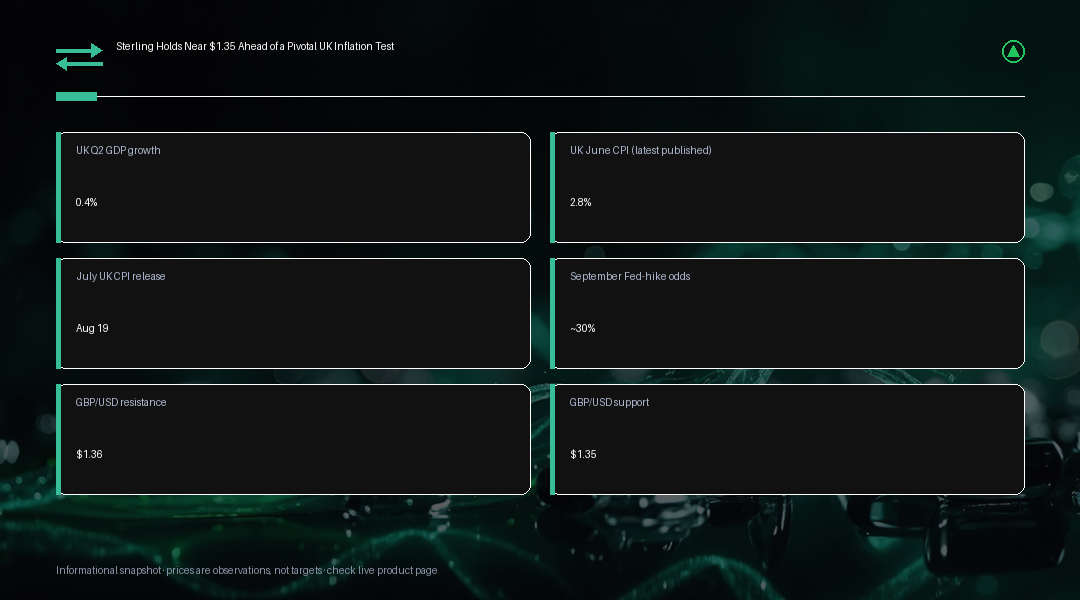
Sterling has spent the past several sessions consolidating near the $1.35 handle against the dollar, a level that reflects two separate stories converging at once: a UK economy that keeps outperforming modest expectations, and a US policy outlook that has grown noticeably less hawkish. The Office for National Statistics confirmed that UK gross domestic product expanded 0.4% in the second quarter, while monthly output for June rose a better-than-expected 0.3%, giving the Bank of England more room to keep fighting inflation without immediately choking off growth. That combination of resilient activity data and a softer US dollar has been enough to keep the pound firm without pushing it decisively through the next major technical hurdle.
The central event for sterling this week arrives Wednesday, when the ONS is due to publish the July UK Consumer Price Index. The release matters because it will show whether inflation is continuing to ease from its most recently published reading, a 2.8% annual rate for June, or whether price pressure is proving stickier than policymakers would like. Markets are watching the print closely for clues on whether the Bank of England has room to extend its current rate-cutting cycle or whether it needs to hold rates higher for longer, and any surprise in either direction is likely to move the pound quickly given how tightly GBP/USD has been trading around current levels.
Energy costs add a genuine complication to that inflation outlook. Brent crude has been trading close to $90 a barrel after a sharp rally driven by stalled US-Iran talks and a marked slowdown in tanker traffic through the Strait of Hormuz, and Britain's heavy reliance on imported energy means higher oil prices tend to filter through to the country's inflation figures faster than in less energy-import-dependent economies. A period of sustained elevated crude prices would complicate the Bank of England's task just as it is trying to assess whether underlying price pressure is genuinely fading, and traders should treat the oil market as a live input into the UK rate story rather than a side issue.
On the other side of the pair, the US dollar has been softening as traders scale back expectations for further Federal Reserve tightening. Weak July employment data, cooling consumer and producer inflation readings, and an unexpected 0.6% monthly decline in retail sales have combined to push market pricing for a September Fed rate increase down toward roughly 30%, a meaningful drop from levels seen earlier in the summer. That repricing has been a genuine tailwind for sterling, widening the perceived gap between where UK and US interest rates are headed and giving cable a rate-differential argument that has held up even without a fresh domestic catalyst.
The Federal Reserve's own calendar adds another layer to Wednesday's setup. Minutes from the Fed's July 28-29 meeting are due for release the same day as the UK inflation report, and it is worth remembering that those minutes describe a meeting that predates the recent run of weaker US employment, inflation and retail-sales data. Traders should treat the minutes as a look back at how divided officials were at the time, rather than as a real-time read on how the Fed views the most recent data, and any market reaction should be weighed against that lag.
UK retail sales figures are also due later this week, offering a second read on whether the resilience seen in second-quarter GDP has survived the pressure of higher household bills. A strong print would reinforce the case that the UK economy can keep absorbing tighter policy without stalling, while a weak one would raise fresh questions about how much further the recent run of positive growth surprises can extend. Either outcome is likely to interact with Wednesday's inflation data in shaping the market's near-term view of the Bank of England's next move.
From a technical perspective, MC Markets' desk view treats $1.36 as the immediate resistance area for GBP/USD, with a further ceiling near $1.37 if that level gives way. On the downside, support sits around $1.35, with a deeper floor in the $1.33 to $1.34 zone should sentiment shift. These levels reflect the pair's recent trading range rather than a fixed prediction, and a hotter-than-expected UK inflation print paired with dovish Fed minutes would be the combination most likely to unlock a push toward the upper end of that range, while the reverse mix would put the lower levels back in play.
Taken together, this week's calendar leaves GBP/USD balanced between two central bank narratives that are moving in partially offsetting directions: a Bank of England that still has genuine inflation work to do, and a Federal Reserve that markets increasingly believe is done tightening for now. That balance is exactly why the pair has been able to hold its ground near multi-week highs without extending aggressively higher, and why Wednesday's back-to-back UK inflation print and Fed minutes release carries outsized importance for where the pair heads into the end of the month.
Trading Insight
For traders, Wednesday's back-to-back release of UK inflation data and Fed minutes is the clearest volatility catalyst on the calendar this week. A hotter-than-expected July CPI print, especially if it comes in above the recently published 2.8% June rate, would strengthen the case for continued Bank of England vigilance and could push GBP/USD toward the $1.36 resistance area, with a break there opening the path to $1.37. Conversely, a softer inflation read paired with dovish-leaning Fed minutes would undercut the rate-differential argument that has supported sterling and could send the pair back toward $1.35 and, on a deeper pullback, into the $1.33 to $1.34 support zone. Because the Fed minutes describe a meeting that predates the latest US data, traders should weight any dollar reaction to them less heavily than the reaction to Wednesday's UK inflation print itself. Later-week UK retail sales data adds a second test of economic resilience, and a weak reading there could reinforce a move already underway from the inflation report rather than acting as an independent catalyst. Given the proximity of current levels to both support and resistance, position sizing into Wednesday's data cluster should account for the real possibility of a sharp, two-way move rather than a gradual drift in either direction.