

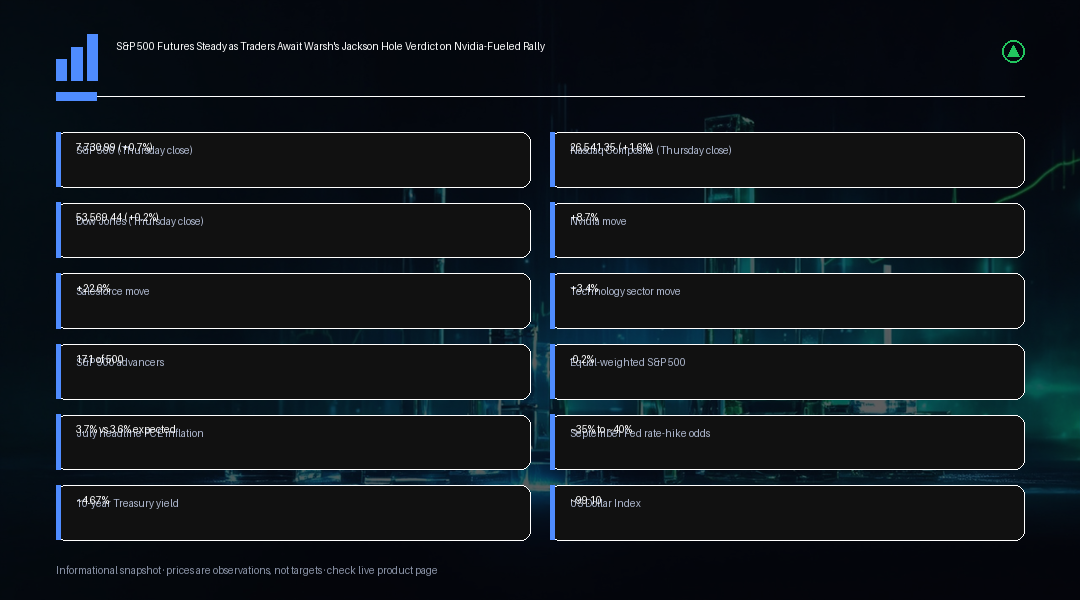
US stock index futures were little changed in the latest premarket snapshot on Friday, with S&P 500 futures essentially flat and Nasdaq contracts down a fraction of a percent, as traders held position ahead of Federal Reserve Chair Kevin Warsh's first Jackson Hole keynote at 10:00 a.m. Eastern time. The muted futures action follows one of the more dramatic technology-led sessions of the year: Thursday's cash session saw the S&P 500 climb 0.7%, closing at 7,730.99 within reach of its record high, while the Nasdaq Composite surged 1.6% to end at 26,541.35 and the Dow Jones Industrial Average added 0.2%, finishing at 53,569.44.
Thursday's rally was powered almost entirely by two earnings reports. Nvidia jumped roughly 8.7% after beating quarterly estimates and forecasting revenue growth near 70% for the next fiscal year, an unusually bold guide for a company already generating tens of billions of dollars in quarterly revenue. Salesforce surged even further, gaining about 22.6% after it raised its annual outlook and reported accelerating growth in its Agentforce artificial-intelligence product line, results that pushed back against fears that generative AI would erode demand for traditional enterprise software rather than expand it.
Technology was, by a wide margin, the S&P 500's best-performing sector on Thursday, rising roughly 3.4% for the session. Nvidia alone added close to $456 billion in market value, nearly matching the entire index's approximate $482 billion increase for the day, with Salesforce contributing another meaningful chunk of that gain. The scale of those two contributions relative to the whole index is the detail traders should not skip past: this was a concentrated, mega-cap-driven rally rather than a broad-based advance.
That concentration shows up clearly in the market's internals. Only about 171 of the S&P 500's constituents actually advanced on Thursday, while the equal-weighted version of the index, which strips out the outsized influence of the largest names, actually fell around 0.2%. In other words, the headline benchmark rose because its largest, most heavily weighted stocks carry disproportionate influence on the index calculation, not because investors were broadly buying equities across the board. Traders should treat that divergence as a signal of narrow leadership rather than confirmation of a broad-based risk-on shift.
Asia's handover into Friday was similarly mixed rather than uniformly celebratory. Taiwan's benchmark climbed around 1.2% and Japan's Nikkei added 0.5%, both markets with heavy exposure to the AI hardware supply chain that Nvidia's results validated. South Korea's Kospi and Hong Kong's Hang Seng declined, however, and the broader Asia-Pacific regional index added just 0.1% on the day, underscoring that Thursday's enthusiasm did not translate into a uniform regional rally.
The macro backdrop keeping futures pinned near the flatline centers on Warsh's Jackson Hole remarks, which carry more nuance than a simple hawkish-or-dovish framing suggests. It is worth being precise about what the event is: Jackson Hole is a policy speech and not a Federal Open Market Committee meeting, so it will not itself produce a rate decision. The next scheduled FOMC meeting is set for September 15 and 16. What the speech can do is move market expectations for that meeting through Warsh's tone on inflation, labor-market conditions and the Fed's broader reaction function.
Those expectations have already been shifting heading into the speech. July headline PCE inflation accelerated to 3.7%, above the 3.6% economists had expected, keeping upward pressure on rate-hike odds. Market-implied pricing has shown a September rate-increase probability in a range of roughly 35% to 40% in recent sessions, with odds of a move by December estimated near 75%, according to Fed funds futures tracked by multiple market-data providers. Traders should treat any single probability figure as a snapshot rather than a fixed fact, since Fed funds futures pricing shifts continuously as new data and Fedspeak arrive, but the broader direction is consistent: markets see a meaningfully live chance of tighter policy at the September meeting.
Cross-asset pricing reflects that same tension. The ten-year Treasury yield held near 4.67% heading into the speech, while the dollar index traded around 99.10, close to a one-week high. Gold slipped about 0.5% toward $4,575 and Bitcoin held near $80,000, both consistent with a market bracing for a potentially hawkish signal rather than positioning for imminent easing. Brent crude, meanwhile, hovered near $90 but remained on track for a weekly decline exceeding 5%, as Iran and Oman discussed steps toward restoring shipping traffic through the Strait of Hormuz, a talks process that has recurred without a concrete resolution.
A genuinely hawkish tone from Warsh, emphasizing the still-elevated inflation print and reserving the option of a September move, could lift Treasury yields further and put immediate pressure on Thursday's expensive technology winners, given how much of the index's recent gain is concentrated in a handful of richly valued AI-linked names. A more balanced or less hawkish message, by contrast, could ease immediate rate concerns and support a broader continuation of Thursday's advance, potentially even helping narrow the gap between the headline index and its equal-weighted counterpart if buying interest extends beyond mega-caps.
For traders positioning around the speech, the practical takeaway is to treat Thursday's rally and Friday's flat futures as two separate signals rather than one continuous story. The earnings-driven strength in Nvidia and Salesforce reflects company-specific fundamentals that are unlikely to reverse based on a single speech. The macro overlay from Jackson Hole, however, will determine whether that strength can broaden into the rest of the market or whether narrow, mega-cap-led leadership remains the dominant pattern heading into September's FOMC meeting.
Options positioning ahead of the speech also points to elevated two-way volatility expectations rather than a settled consensus view. Index option markets have been pricing wider-than-normal implied moves for the S&P 500 around Fed speaker events this year, reflecting how sensitive current valuations have become to shifts in the rate-cut and rate-hike calculus. With technology now representing an outsized share of index-level gains, even a modest repricing of rate expectations can produce an outsized swing in benchmark index levels, which is why traders should size positions around the speech with that asymmetry in mind rather than assuming Friday's flat futures print will simply carry through to a quiet session.
Trading Insight
The setup into Warsh's Jackson Hole address argues for scenario-based positioning rather than a single directional bet. MC Markets does not cite exact source levels without independent market-data verification, so treat any specific support, resistance or target figure as indicative rather than guaranteed. A hawkish tone that reinforces the still-elevated July PCE print and keeps September rate-hike odds elevated would likely pressure Treasury yields higher and put the most stress on the same richly valued technology names that drove Thursday's gain, particularly given how narrow the day's advance already was based on the roughly 171 advancing constituents and the equal-weighted index's decline. A more balanced message could support a broadening of Thursday's rally beyond mega-caps. Either way, traders should watch whether the ten-year yield, the dollar index and gold move together in a coherent hawkish or dovish direction after the speech, since a mixed cross-asset reaction would suggest the market has not yet settled on an interpretation.