


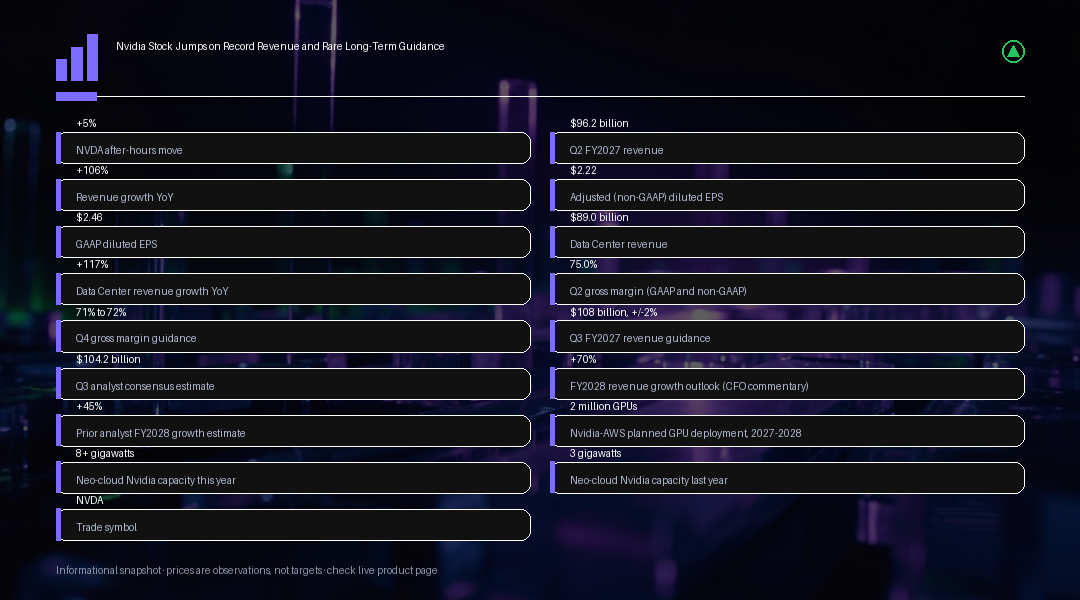
Nvidia shares rose more than 5% in after-hours trading after the chipmaker reported fiscal second-quarter revenue that more than doubled year over year to a record $96.2 billion and issued a fiscal third-quarter revenue outlook of roughly $108 billion, comfortably above what Wall Street had penciled in. The results, covering the quarter ended July 26, 2026, extended a run of blowout prints that have made Nvidia the bellwether for the broader artificial intelligence infrastructure buildout.
The headline numbers were strong across the board. Revenue of $96.2 billion, up 106% year over year and 18% quarter over quarter, beat the roughly $91.9 billion analysts had expected. Adjusted, non-GAAP diluted earnings per share came in at $2.22, ahead of the $2.08 consensus estimate, while GAAP diluted EPS was $2.46. Gross margin held at 75.0% on both a GAAP and non-GAAP basis for the quarter, though management guided margin down toward a 71% to 72% range for the fourth quarter as rising memory and component costs weigh on profitability even as sales keep climbing.
Data center revenue, by far Nvidia's largest and fastest-growing segment, surged 117% year over year to $89.0 billion, ahead of the roughly $85.08 billion analysts had modeled. That segment now represents the overwhelming majority of Nvidia's total business and continues to be driven by hyperscale cloud providers and AI labs racing to secure computing capacity.
Nvidia guided fiscal third-quarter revenue to approximately $108 billion, plus or minus 2%, well above the roughly $104.2 billion Wall Street consensus. Notably, that outlook assumes no data-center compute revenue from China, where H200 shipments remain limited and unpredictable under current export restrictions. Chief Financial Officer Colette Kress also told investors the company expects revenue to grow by roughly 70% in fiscal 2028, a figure well above the approximately 45% growth analysts had been modeling. That commentary should be read as management's longer-term outlook rather than formal quarterly guidance, but the scale of the gap against prior Street expectations helped fuel the after-hours rally.
On the earnings call, Chief Executive Jensen Huang described the AI computing shift as having reached what he called an inflection point, arguing that AI-generated computing is now producing measurable, monetizable revenue for customers rather than remaining an expensive experiment. That framing matters for the stock's valuation debate, since skeptics have long argued that AI infrastructure spending would eventually need to show a return on investment for enterprise customers, not just growth in chip shipments.
The next-generation Vera Rubin platform is now in full production and ramping at major cloud and infrastructure partners, and management expects it to contribute around one-fifth of data-center revenue this quarter already. Nvidia and Amazon Web Services also outlined plans to deploy an additional two million GPUs during 2027 and 2028, giving investors unusually long visibility into demand well beyond the current product generation. Separately, OpenAI is expected to represent roughly a quarter of Nvidia's total business next year, underscoring how concentrated demand remains among a small number of very large AI developers.
Specialist AI infrastructure providers often called neo-clouds, including CoreWeave and Nebius, could finish the year running more than eight gigawatts of Nvidia computing capacity, up from roughly three gigawatts a year earlier. That near-tripling in a single year illustrates how quickly capital is flowing into dedicated AI data-center capacity outside the traditional hyperscalers, adding another demand channel alongside cloud giants and AI labs.
Nvidia remains supply-constrained, particularly in memory components, which is the primary reason management guided gross margin lower into the fourth quarter even as revenue keeps climbing. China remains a genuine swing factor: the current outlook assumes essentially no data-center compute revenue from the region, meaning any easing of export restrictions would represent upside not currently reflected in guidance, while further tightening would have limited incremental downside since China is already excluded from the base case.
The scale of the after-hours move reflects how far Nvidia has once again cleared already-elevated expectations, but the stock's regular-session reaction will be the more meaningful test of whether the market treats this quarter as confirmation that AI infrastructure spending remains durable, or as a peak-optimism print that will be judged against tougher comparisons in future quarters. Traders should also separate Nvidia's own fiscal 2028 growth commentary, which is management's internal expectation, from the broader market's assumptions about industry-wide AI capital spending, which involve considerably more moving parts.
Nvidia's results also carry read-through for the wider semiconductor and AI supply chain. Foundry partner TSMC and memory suppliers such as SK Hynix and Samsung sit directly upstream of Nvidia's data-center build-out, and the guided step-up toward $108 billion of fiscal third-quarter revenue implies continued heavy order flow across that chain in the months ahead. At the same time, the memory-driven margin pressure Nvidia flagged for its own fourth quarter is a reminder that component tightness cuts both ways: it supports supplier pricing power even as it compresses Nvidia's own profitability.
Competitive dynamics remain part of the debate even after a quarter this strong. Custom AI silicon efforts from hyperscale cloud customers, and merchant alternatives from rivals, continue to be cited by skeptics as a long-run risk to Nvidia's dominant data-center share. Thursday's numbers do not resolve that debate, but the combination of record Data Center revenue, the fast ramp of the Vera Rubin platform and multi-year GPU commitments from a partner as large as Amazon Web Services suggest Nvidia's current platform advantage remains intact heading into fiscal 2028.
Trading Insight
For traders watching NVDA, the most important distinction in this report is between formal guidance and management commentary. The $108 billion fiscal third-quarter revenue guidance, with its plus-or-minus 2% range, is Nvidia's official target, while the roughly 70% fiscal 2028 growth figure is CFO commentary that carries more uncertainty and depends on execution across supply, memory availability and continued hyperscaler capital spending. MC Markets does not cite exact source levels without independent market-data verification, so confirm current support and resistance zones independently before trading around this move. Watch the gross margin trajectory toward the 71% to 72% range as a signal of how much rising memory costs are eating into the bottom line even as revenue growth remains historically strong, and monitor whether any change in China export policy shifts the China-excluded assumption baked into current guidance.