


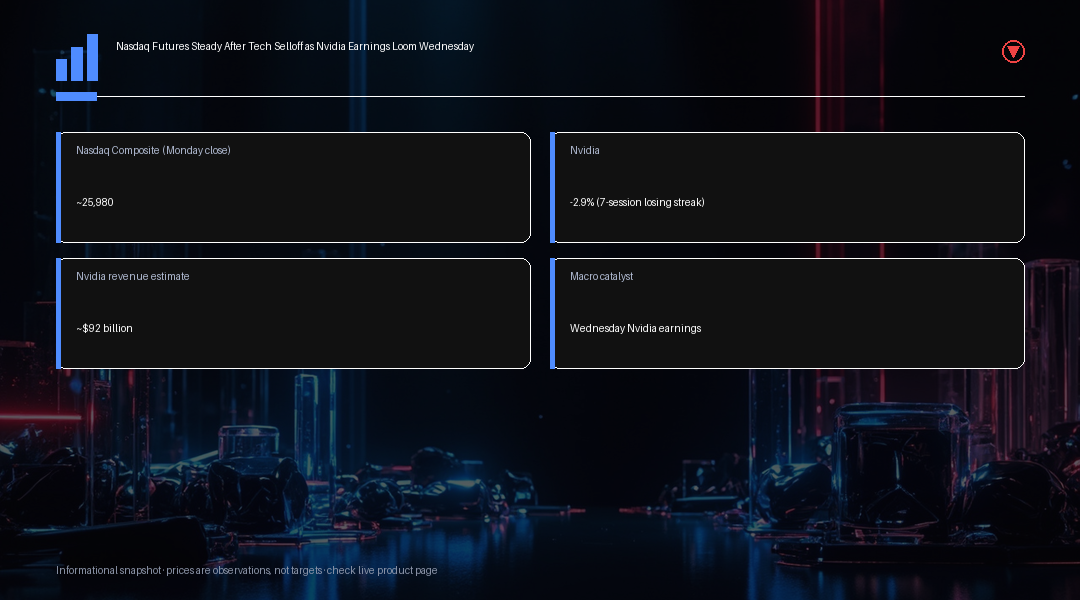
Nasdaq futures are holding close to the flatline on Tuesday after a rough Monday session in which the Nasdaq Composite dropped roughly 200 points, or about 0.8%, to close near 25,980. The S&P 500 slipped a more modest 0.3% to around 7,652.86, while the Dow Jones Industrial Average managed to gain about 0.3%, or roughly 140 points, as financial stocks provided a pocket of relative shelter. The divergence between the tech-heavy Nasdaq and the more diversified Dow is itself informative: this was a selloff concentrated in artificial-intelligence and semiconductor names rather than a broad risk-off move across the entire market.
Nvidia sat at the center of Monday's decline, falling roughly 2.9% and extending its losing streak to seven consecutive sessions heading into its earnings report, which is scheduled for Wednesday, August 26, after the US market close. Other chipmakers followed a similar path, with Micron down around 6% and Sandisk losing roughly 6.5%. Consensus estimates going into the report point to earnings per share near $2.09 on revenue of approximately $92 billion, though the more important variables for the stock's reaction are likely to be third-quarter guidance, gross margin trends, and commentary on demand for the Blackwell chip platform, since those forward-looking signals tend to matter more to valuation than the backward-looking headline numbers alone.
The selloff did not stay contained to US markets. Asian equities absorbed a heavier version of the same pressure on Tuesday, with South Korea's Kospi index sliding about 2.7%, Japan's Nikkei down roughly 0.9%, and the broader Asia-Pacific index off about 0.5%. Chip-heavy Asian markets are especially sensitive to Nvidia's outlook because its guidance shapes demand expectations across memory chips, semiconductor manufacturing equipment, and data-center supply chains that stretch across the region. Adding to the regional unease, Samsung's shareholder-return plan underwhelmed investors, while Alibaba's discounted $10.2 billion share placement reignited a familiar question hanging over the AI infrastructure buildout: how much additional dilution and debt issuance will be required to keep funding the current pace of capital spending.
A closer look at Monday's US session shows the damage was broader than the three headline indices alone suggest. Market breadth, meaning the ratio of advancing to declining stocks, was notably weak, which indicates the Dow's modest gain reflected a narrow rotation into financials and payment-related names rather than a genuine improvement in overall risk appetite. Traders appear to have used Monday's session to trim expensive technology exposure ahead of Wednesday's main event, a pattern that is common in the days leading into a heavily anticipated earnings report from a stock as large and influential as Nvidia has become.
July's PCE inflation data, the Federal Reserve's preferred inflation gauge, is also due Wednesday, ahead of Nvidia's after-hours report, adding a second layer of event risk to the same session. Consensus estimates put core PCE near 3.3% on an annual basis, though this figure should be treated as a market expectation rather than a confirmed outcome until the data is released. A hotter-than-expected inflation print could lift Treasury yields and add fresh pressure to already-stretched technology valuations well before Nvidia's numbers are even public, effectively compounding the risk traders are already carrying into the session.
Commodity and currency markets are telling a more mixed story than equities alone. Oil prices eased after Washington's much-discussed set of new measures against Iran, described in market commentary as an economic deadline of sorts, ultimately produced fewer immediate steps than some traders had feared, with Brent crude trading near $92 a barrel and WTI near $85. The US dollar lacked clear direction, with EUR/USD holding above $1.16 and USD/JPY sitting below the JPY159 level. Meanwhile, gold pushed up to around $4,668 an ounce, its strongest level since May, and Bitcoin traded near $80,000 after an explosive weekly rally. That split, AI-linked risk assets under pressure while traditionally defensive and scarce assets stay well bid, suggests investors are actively hedging against the AI trade rather than abandoning risk assets altogether.
For traders positioning into Wednesday, the setup effectively stacks two distinct binary events into a single session: a macro inflation print in the morning and Nvidia's earnings after the close. That sequencing raises the stakes for anyone holding AI-adjacent exposure through the full day, since a hot PCE print could already pressure valuations before Nvidia's numbers cross the wire, leaving less room for the earnings report alone to move sentiment in a clean, isolated way. Historically, Nvidia has beaten consensus estimates in each of its past several reports, yet has still seen its shares decline the following session each time, a pattern that underscores how much of the good news is typically already priced in before results land.
The practical read for active traders is that Tuesday's calm in Nasdaq futures should not be mistaken for a market that has resolved its underlying tension. Watch the 25,980 area on the Nasdaq Composite as the reference point for Monday's close, with a recovery above that level suggesting the selloff was a short-term positioning adjustment ahead of earnings rather than a deeper shift in sentiment. On the other hand, a break meaningfully below that level, especially if it comes alongside a hot PCE print, would raise the odds that Wednesday's session turns into a broader repricing of AI-linked valuations rather than a single-stock earnings story. Either way, sizing risk for a session that combines a major macro data point with the highest-profile earnings report of the week deserves more caution than an ordinary trading day.
Trading Insight
Treat the Nasdaq Composite's Monday close near 25,980 as the reference level heading into Wednesday's double catalyst of July PCE inflation data and Nvidia's after-hours earnings report. A recovery back above that level into Wednesday would suggest Monday's selloff was largely a positioning adjustment ahead of earnings, while a break meaningfully lower, particularly alongside a hot PCE print, would raise the odds of a broader repricing in AI-linked names rather than an isolated single-stock move. Because Nvidia has historically beaten estimates yet still traded lower the next session in its past several reports, focus on guidance, gross margins, and Blackwell demand commentary rather than the headline beat alone when the numbers land.