

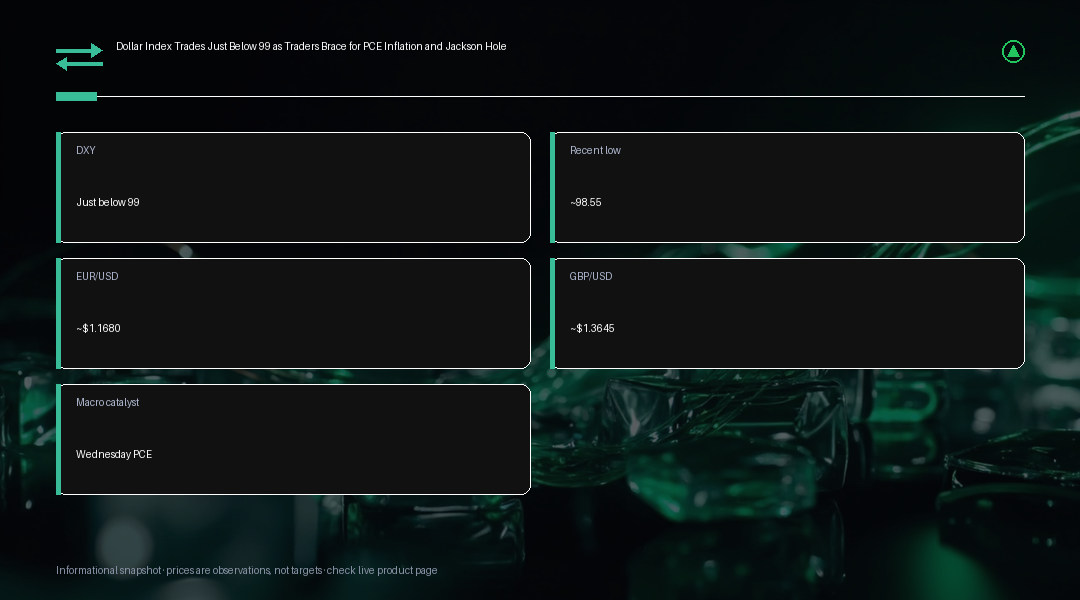
The US Dollar Index is trading just below the 99 handle, struggling to build on a modest rebound from three-month lows as a mix of fiscal policy signals and looming macro data leave the greenback without a clear directional anchor. The index, which measures the dollar against six major currencies with a heavy weighting toward the euro, recently touched levels near 98.55 before stabilizing, and the broader message from price action is that the dollar's usual safe-haven and yield-driven support is being complicated by concerns closer to home.
At the center of that complication is Washington's plan to expand Treasury bond buyback operations, a policy officially designed to improve liquidity in the bond market and ease long-term borrowing costs. Markets, however, have increasingly interpreted heavier official intervention in debt markets as a signal that authorities are prioritizing funding conditions over currency strength, feeding into what traders have nicknamed the debasement trade, the idea that expanding official support for government debt can eventually dilute a currency's purchasing power. The tension this creates is real: two-year Treasury yields have held near 4.25% and ten-year yields near 4.70% in recent sessions, levels that would typically support the dollar, yet fiscal-policy concerns are offsetting that usual relationship for now.
Currency rivals have used the opening to build some altitude of their own. EUR/USD has traded near $1.1680, close to a three-month high, while GBP/USD has pushed toward $1.3645, close to a six-month peak. Neither move should be read as a sudden improvement in the eurozone or UK growth outlook; both currencies are gaining primarily because the dollar side of the pair has softened rather than because of a fresh domestic catalyst. USD/JPY has eased toward the JPY159 area, though the yen has given back much of the ground it gained from earlier coordinated intervention, while USD/CAD has held near C$1.3844 after proposed 50% US tariffs on Canadian autos weighed on the loonie. Elsewhere, expanded sanctions on Iran could create pockets of forced dollar demand, since institutions and countries that continue doing business with Tehran risk exclusion from the dollar-based financial system and may move to secure dollars defensively.
The near-term path for the index now depends heavily on two scheduled events. July's PCE inflation report, the Federal Reserve's preferred inflation gauge, is due Wednesday, with consensus estimates pointing to roughly a 0.2% monthly increase and an annual core reading near 3.3%. It is important to treat those figures as pre-release consensus estimates rather than confirmed data until the report actually lands. A hotter-than-expected print would tend to revive rate-hike speculation, lift Treasury yields, and could drag the index back above 99 toward the psychologically significant 100 level. A softer print would likely reinforce the debasement-trade narrative already in play and expose the recent lows near 98 for a retest.
The second major catalyst is Fed Chair Kevin Warsh's address at the Jackson Hole symposium on Friday, where traders will be listening for clarity on the future path of interest rates, the recent stress evident in long-duration bond markets, and the broader question of how much fiscal policy is beginning to influence what is normally viewed as an independent central bank. A hawkish tone from Warsh, emphasizing vigilance against inflation and a willingness to keep policy tight, would tend to support the dollar. A more cautious or accommodative tone, particularly one that appears to defer to fiscal pressures, would likely weigh on the currency and keep the debasement trade narrative firmly in control.
Put simply, the dollar is facing something close to a credibility test over the coming days. Monetary hawkishness on its own has historically been enough to support the greenback, but that relationship only holds if fiscal policy is not simultaneously working against it by expanding debt-market intervention. Until the market gets clarity from both PCE and Jackson Hole, expect the index to keep trading in a relatively wide band around the 98 to 99 area, with any decisive break in either direction likely to come only after one or both catalysts have passed.
For traders positioning around this event risk, the sequencing matters as much as the direction. PCE lands first and will shape expectations heading into Warsh's remarks two days later, meaning a surprise in Wednesday's data could set the tone for how the market interprets Friday's commentary rather than the other way around. A hot PCE print followed by a hawkish Warsh would be the cleanest combination for a dollar rebound back toward 100, while a soft PCE print paired with a cautious Warsh would be the cleanest combination for a break of the recent 98 lows. Mixed outcomes, such as a hot print followed by a dovish-leaning Warsh, are arguably the more likely scenario given the current fiscal backdrop, and would probably keep the index rangebound rather than resolving cleanly in either direction.
Cross-asset context reinforces the point that this is a genuine two-way risk setup rather than a one-directional bet. Gold's parallel strength and Bitcoin's recent rally both suggest that broader capital has already begun hedging against the debasement narrative regardless of what the dollar index does next, which is a useful signal that positioning across markets is already leaning toward caution on the currency's medium-term trajectory even as short-term price action stays technically undecided.
The tariff angle adds another layer worth tracking alongside the two main catalysts. Proposed 50% US tariffs on Canadian autos have already weighed on USD/CAD, and any escalation or de-escalation in that specific trade dispute could move the loonie independently of the broader dollar story playing out through PCE and Jackson Hole. Traders active in USD/CAD should watch for headlines on the tariff timeline separately from the macro calendar, since a resolution or delay could produce a sharp, isolated move in that pair even while the broader dollar index stays rangebound waiting on Wednesday and Friday's events. The same logic applies to the Iran-sanctions angle: any escalation there could add a defensive bid for dollars from institutions seeking to stay clearly inside the dollar-based financial system, a flow that would not necessarily show up as broad dollar strength across every major pair at once.
Trading Insight
Watch the 98 to 99 band as the near-term battleground, with a close back above 99 needed to open a path toward the psychological 100 level and a break of 98 needed to confirm a deeper retest of three-month lows. Sequence the two catalysts: Wednesday's PCE print will likely set the tone for how markets interpret Fed Chair Kevin Warsh's Friday remarks at Jackson Hole, so treat the two events as connected rather than independent. A hot PCE print paired with hawkish Jackson Hole commentary is the cleanest setup for dollar strength, while a soft print paired with a cautious tone is the cleanest setup for renewed weakness; mixed outcomes argue for a rangebound market until the picture clears.