


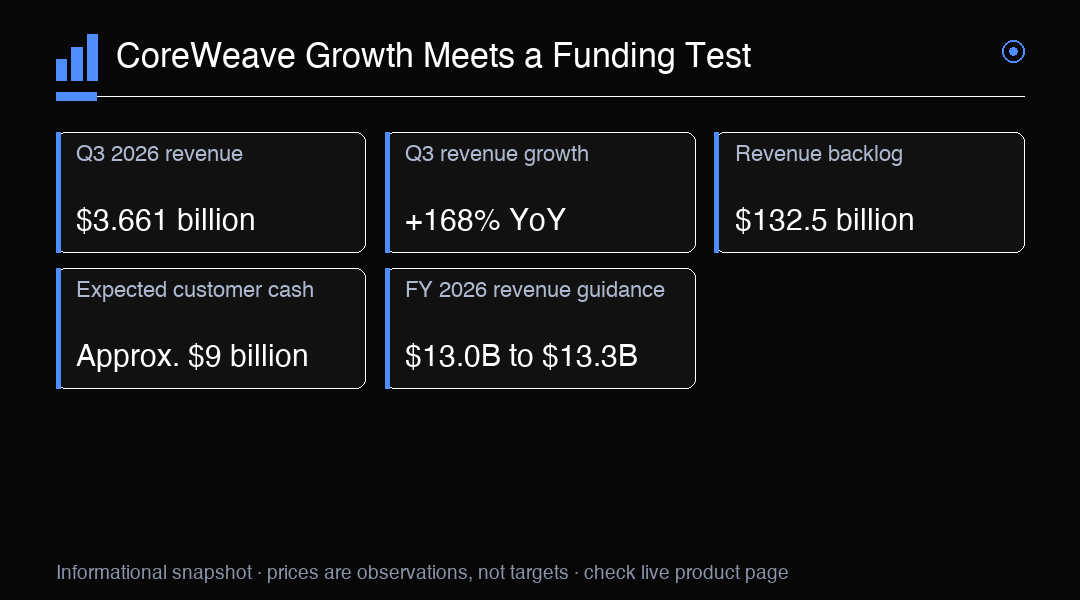
CoreWeave’s third-quarter results show a business expanding at extraordinary speed while carrying a demanding infrastructure bill. Revenue reached $3.661 billion, up 168% year over year. Adjusted operating income was $379 million and adjusted operating margin was 10%. At the same time, the company reported a GAAP net loss of $709 million, or $1.27 per basic and diluted share. These measures describe different parts of the same business: operating performance improved, while the full accounting result remained negative. The central question for investors is whether CoreWeave can turn contracted demand into delivered capacity and cash generation at a pace that supports its investment needs.
The approximately $132.5 billion revenue backlog is a large indicator of contracted demand, but it is not equivalent to revenue already earned, cash already received, or guaranteed profit. Conversion depends on CoreWeave bringing data centers online, securing available power, installing computing equipment and making capacity available when customers need it. Delivery schedules and service availability therefore matter as much as the headline backlog. Delays can push expected revenue into later periods, while changes in customer requirements or deployment timing can affect how quickly contracts translate into billings. Investors should read backlog as a visibility measure with execution conditions attached, rather than as a direct forecast of near-term sales or cash flow.
That distinction is especially important for a company whose product depends on physical infrastructure. Computing capacity requires sites, power, networking, specialized equipment and operational readiness. Each component must arrive and work in sequence. A facility that is built but lacks power, or equipment that arrives before a site is ready, may not produce billable service on the intended timetable. CoreWeave’s reported backlog thus concentrates both opportunity and execution risk: it offers a substantial base of customer commitments, while increasing the importance of timely delivery across multiple linked constraints. The market will need evidence that new capacity is becoming usable and serving customers, not merely that contracts continue to accumulate.
Customer prepayments and deposits offer a second important piece of the funding picture. Management expects approximately $9 billion over the next three months. These amounts can provide cash before all associated services are delivered, helping fund the capital required to support customer commitments. They also connect financing to customer demand: customers willing to pay ahead can help support deployment, and their commitments may provide added visibility. But prepayments do not erase the obligation to build and provide the contracted service. They change the timing of cash receipts and may support investment; they should not be confused with recurring revenue, profit, or unrestricted cash that carries no future delivery commitments.
The quality and timing of those expected receipts still matter. The $9 billion figure is a management expectation for the coming three months, not cash already collected. Actual amounts and timing can differ, and funds received in advance are linked to future service obligations. Investors should watch subsequent reporting for collections, customer concentration, contract terms and whether the expected capacity reaches service. A prepayment can strengthen near-term liquidity while also raising the operational stakes: customers have funded part of a future service, and CoreWeave must execute. The figure is therefore best understood as a meaningful funding source and a testable forward-looking expectation, not a standalone resolution of the company’s financing requirements.
Capital expenditure makes that financing test tangible. CoreWeave spent $14.5 billion on capital expenditures in the third quarter and guided to $37 billion to $39 billion for the full year. Those sums reflect a business building aggressively for anticipated demand, but they also create substantial cash needs before all newly deployed assets generate revenue. The investment cycle can widen the gap between growth in reported sales and the resources needed to support future growth. Investors should assess whether spending produces capacity on schedule, whether that capacity is taken up by customers, and whether the resulting revenue and operating contribution justify the capital committed.
Execution quality matters because higher spending alone does not guarantee stronger returns. Projects can face construction, power, equipment, financing or commissioning constraints. When capacity is delayed, capital may be tied up before the associated service becomes available. When capacity arrives on time, CoreWeave still needs customers to use it under contract terms that support sustainable economics. The 10% adjusted operating margin is a useful operating indicator for the quarter, but it should be interpreted alongside the GAAP loss, capital expenditure and financing costs. Adjusted measures can help isolate operating trends, while the reported net loss captures costs and accounting effects that remain relevant to shareholders.
Full-year 2026 revenue guidance of $13.0 billion to $13.3 billion signals management’s current expectations, not a settled outcome. The range depends on assumptions about customer demand, delivery schedules and the availability of service capacity. It should be considered together with the company’s capital expenditure plan and funding sources. Rapid revenue growth can coexist with heavy investment and financing costs; revenue expansion does not by itself establish that a company can fund every planned deployment on attractive terms. Investors should look for progress across several measures over time: revenue conversion, operating performance, cash collection, capacity delivery and the cost of financing.
Financing costs remain material because infrastructure must often be funded before it produces its full economic contribution. Higher borrowing costs, limited access to capital or a change in lender appetite could make expansion more expensive or require different funding choices. Even when customer contracts support borrowing, future payments depend on service delivery and the customers’ ability and willingness to meet their obligations. The company’s funding needs should therefore be evaluated against cash on hand, operating cash generation, customer receipts, financing availability and investment commitments as those details are reported. A strong backlog can help support financing discussions, but it does not remove the risks of leverage, timing or capital-market conditions.
For broader market context, NAS100 can serve as a broad AI and technology proxy because its performance reflects a range of large technology and growth companies. It is not direct CoreWeave exposure and is not a hedge for CRWV-specific risks. The index can move for reasons unrelated to CoreWeave, while the company can face distinct changes in financing, deployment, customer demand or operating execution. That makes proxy comparisons useful only for general sector context, not as a substitute for company analysis. Risk management should account for the difference between a broad index position and a single infrastructure provider, including the possibility that their prices and risks diverge.
The investment case ultimately rests on conversion and funding discipline. Strong demand and a large backlog can support growth, but investors need to see capacity delivered, customer cash collected and operating results improve in a way that can carry the cost of expansion. The next evidence should be judged against the company’s stated expectations, while preserving the distinction between reported results and forward-looking plans. A measured approach means sizing exposure for the possibility that deployment or funding conditions disappoint, monitoring reported cash and spending alongside revenue, and avoiding assumptions that backlog automatically becomes earnings. CoreWeave’s growth opportunity is substantial; its funding and execution requirements are equally central to how that opportunity may unfold.
Trading Insight
CoreWeave’s results present a conversion question: can contracted demand become available capacity and customer cash quickly enough to support heavy investment and financing costs? Track backlog conversion alongside delivery, collections, operating performance and spending. NAS100 offers broad AI and technology context, but it is not direct CRWV exposure or a hedge for company-specific execution and funding risks.