


Nasdaq 100 futures climbed 1.3% on Monday as investors bought the dip in the artificial intelligence trade, snapping a weeklong selloff that had erased 5.5% from the index. The rebound marked a positive start to a week in which earnings reports will put the AI trade to the test once again. Traders described the move as a relief rally after a stretch of persistent weakness, with dip buyers returning in size as soon as US futures came online. The tone was constructive from the open, and the gain held through the session rather than fading into the close.
S&P 500 futures rose 0.5% and Dow Jones Industrial Average futures ticked 0.17% higher, or 87 points. An exchange-traded fund tracking chip names rallied 3.6% in US premarket trading, leaving it set for a first daily gain in 10 sessions after last week's rout in semiconductor shares. The semiconductor recovery was the clearest signal that the selling had run its course, with the heaviest decliners attracting the strongest bids. Broadening participation suggested the move was not simply a narrow rotation back into a handful of megacap names.
The recovery came after a closely watched semiconductor gauge posted its longest losing streak since 2008. The volatility index touched a four-month intraday high before retreating, suggesting traders are regaining confidence after the recent bout of selling. The pullback in implied volatility was just as telling as the rally itself, since a calm derivatives market typically encourages discretionary buyers to re-engage. Traders noted that positioning had become excessively defensive after the prior week's decline, leaving room for a sharp reversal once the selling pressure eased.
The busy earnings week ahead will be a key test for the AI trade. Major technology companies are set to report results that will reveal whether the massive capital spending on AI infrastructure is translating into revenue growth. Investors will be watching for signs that the spending is producing measurable returns, particularly in cloud and data-centre segments. Guidance for the coming quarters will matter as much as the reported numbers, since the market has been willing to pay a premium only for evidence of durable growth.
Wall Street strategists note that the recent dip buying suggests institutional investors remain committed to the AI theme. The selloff last week was driven by profit-taking rather than a fundamental reassessment of the technology's potential. The rebound indicates that buyers are still willing to step in on weakness, a pattern that has defined the market for much of the year. Several desks reported that long-only accounts were among the more active participants on the bid side, which points to a longer-horizon commitment rather than short-term speculation.
European equities were mixed, with the Stoxx 600 falling 0.9% following a weekend of violent protests in France. Asian equities were expected to decline at the start of trading, though futures indicated a potential rally for the evening session. Australia's S&P/ASX 200 rose 0.3%. The divergence across regions reflected local political and economic pressures rather than a uniform global risk mood, and traders said the US session would ultimately set the direction for the rest of the week. Trading volumes in Europe were below average, which is common when investors are waiting for fresh catalysts from the other side of the Atlantic.
Oil prices slipped after reaching five-month highs, easing concerns about energy costs and inflation. The decline in oil helped support equities, as lower energy costs reduce pressure on corporate profitability and consumer spending. The dollar also softened, providing additional support to risk assets. A weaker greenback tends to lift the earnings outlook for multinational technology companies, since a large share of their revenue is generated outside the United States and translates back into more dollars when the currency falls. Energy shares were among the few laggards, tracking the pullback in crude.
Analysts note that the market is now in a critical phase where earnings will determine the next major move. If technology companies can demonstrate that AI investments are generating returns, the rally could resume. Conversely, any signs of disappointing results could trigger another round of selling. The bar for beating expectations has risen after the strong run in technology shares, and even in-line results may not be enough to satisfy investors who have grown accustomed to upside surprises. The next few sessions should therefore be read as a referendum on the durability of the AI investment cycle.
The options market shows increased demand for upside exposure, with call volume rising to its highest level in three weeks. Traders are positioning for a continuation of the recent rebound, though caution remains given the high volatility environment. Implied volatility has declined from last week's peak but remains elevated, a combination that suggests optimism about direction alongside lingering uncertainty about magnitude. The skew in the options market has shifted in favour of calls, which often precedes further gains when accompanied by improving fundamentals.
From a technical perspective, the Nasdaq 100 is testing key support at 30,000. A decisive break below that level could open the door to a retest of 29,500. Conversely, a reclaim of 30,500 would signal a return to the recent uptrend and could attract further buying interest. Momentum indicators have begun to turn higher from oversold territory, and a sustained move above the short-term moving averages would reinforce the view that the corrective phase has ended. Volume on the rally was modest, which means the breakout argument remains unproven until participation picks up.
Looking ahead, the coming sessions are expected to bring elevated volatility as earnings reports, macro data and central bank commentary compete for attention. The combination of heavy event risk and thin liquidity between releases means price swings could be exaggerated in both directions. Traders said the market is likely to trade defensively until the bulk of the technology results are behind it, at which point a clearer trend could emerge. The pace of the earnings calendar leaves little room for complacency.
Overall, the market appears to be stabilizing after last week's volatility. The combination of dip buying and easing oil prices has provided near-term support, but the earnings week will likely determine whether the AI trade can resume its upward trajectory or if further consolidation is needed. For now, the rebound has restored some confidence, though the durability of the move will ultimately depend on whether corporate results validate the optimism that has driven the sector for much of the year.
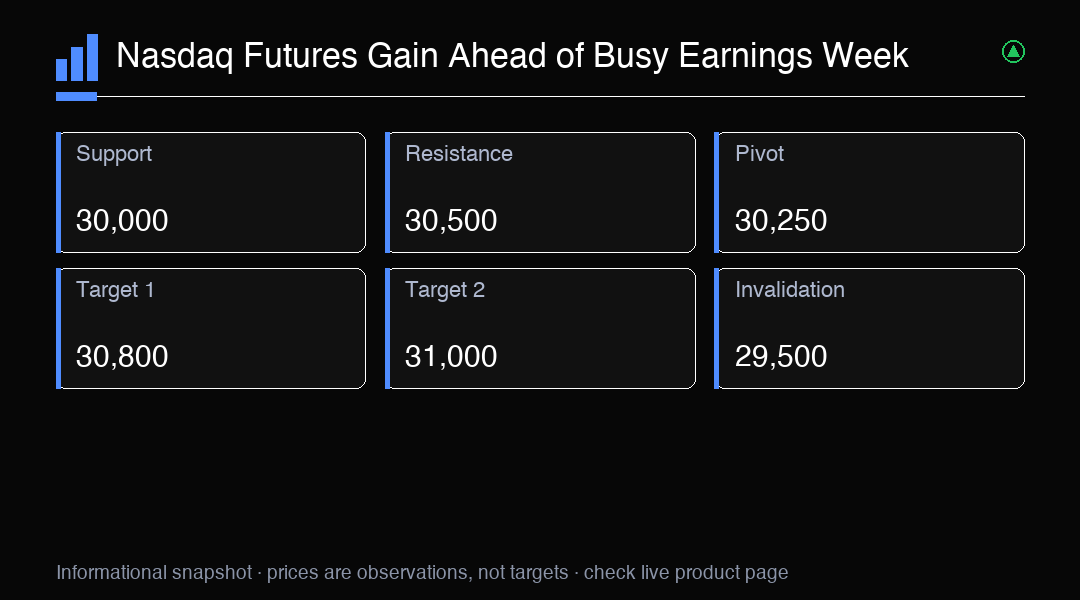
Trading Insight
The Nasdaq 100 is rebounding after the chip rout, with futures up 1.3%. Key support at 30,000. Watch earnings week for direction.